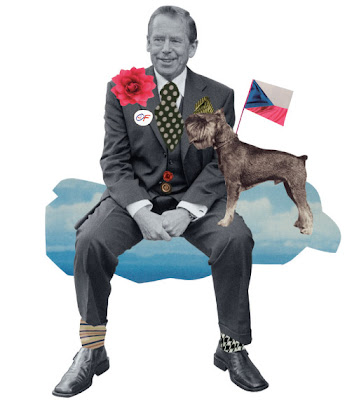
 I have a special affinity for Vaclav Havel. I was an undergraduate when hundreds of thousands of Czechoslovaks filled the streets of Prague in peaceful protest, chased out the grey communist bureaucrats, and installed a playwright as president. The Velvet Revolution enthralled me, and after graduation I joined the thousands of North American twentysomethings who headed for Prague. Havel was by far the most interesting of the dissidents and intellectuals who brought down the Communist regimes all over Eastern Europe, and for a time he made his country the most glamorous place to be in the world. So of course I had to see Citizen Havel, a documentary that follows the playwright-president over his ten-year tenure as president of the Czech Republic after the Velvet Divorce.
It's clear from the opening sequence what kind of film we're watching. Citizen Havel is a throwback to the glory days of cinema vérité, a fly-on-the-wall peek inside Havel's office, his summer house, and the grand presidential residence of Prague Castle. And most of it is shot on film. Film! When was the last time we saw cinema vérité shot on film?
The vérité approach is completely rigorous: no music, no effects of any kind, just the quiet drama and humour of life backstage in Havel's most important play, an improvised work in which he plays himself as President. Havel and his advisors wait for word on the presidential election (decided in a vote by Parliament), they plan state visits (Boris Yeltsin's only request is to have a beer at an "authentic Czech pub"), they entertain the Rolling Stones (Ronnie and Keef ask for a restaurant recommendation), etc. Throughout, Havel appears to be completely comfortable with the presence of the camera, hiding nothing - not his wardrobe conundrums, nor the petty rivalries of day-to-day politics - and occasionally slyly making sure the film crew captures a particularly absurd moment. Even when he's on his way to hospital for a potentially lethal procedure, he invites the film crew along. (That produces a priceless scene: before getting down to the business of medicine, Havel, his wife and his doctors sit down and have a drink together. Maker's Mark bourbon.) It's as if he decided that the best way to show the truth of his most famous statement, "truth and love will triumph over hatred and lies," is to live it on camera.
Now, lest I create the wrong impression, it's not like Havel is the Dalai Lama. His rivalry with Thatcherite premier Vaclav Klaus turns petty, and Havel neuroses over whether he can get away with not inviting Klaus to a jazz-club visit with Bill Clinton. After his wife, Olga, a revered figure in the Czech Republic, dies, he soon re-marries, to a sometime actress who, on the surface at least, couldn't be more different. But in the end, all this just adds to Havel's charm: he is completely comfortable with himself, and is happy to prick his own balloon at every opportunity. As a result, the film is as much observational comedy as political drama, and a reminder of the old saying that a portrait is given as much as it is taken.
There is a tragic coda to this story. Director Pavel Koutecky - to whom Havel chose to entrust this portrait - was killed in an accident before he could finish the film, so Citizen Havel was directed in the cutting room by Miroslav Janek. That's a hugely daunting task for someone who wasn't there when the footage was shot, especially when dealing with such historically and culturally significant material. But on the other hand, that kind of limitation forces you to deal with the material in front of you. You can't worry about what you don't have because you weren't there to see it.
The material Koutecky shot for Citizen Havel is unprecedented, and definitely unrepeatable. I can't imagine any other politician, present or future, giving a filmmaker such access without trying to manipulate the result. This is a truly historic film.
It’s an irresistible premise: a dogged police detective trying to get the goods on a brutal serial killer who’s hiding in plain sight. Dance With a Serial Killer is a true-life policier, like a season-long storyline on Homicide: Life on the Street. How can you go wrong?The story: a woman is stabbed to death on a busy beach in France. No one hears anything, and there’s nothing in the woman’s life that points to a possible motive. The police zero in on a drifter staying at a nearby homeless shelter, one Francis Heaulme, who admits to having random homicidal urges. But the cops have no evidence to tie him to the crime, and have to let him go. What follows is a two-and-a-half-year cat-and-mouse game between detective Jean-François Abgrall and one of the freakiest, most dangerous homicidal maniacs I’ve ever heard about. Dangerous because there is no pattern, no rhyme or reason to his crimes – just opportunity and a desire to kill.So, a hero, a villain, and a chase. What more do you need to make a good documentary? Well, actually, a lot. The film simply follows Abgrall around France, interviewing him in the various places where the story unfolded almost 20 years ago: police stations, isolated fields, etc. There are a few interviews with other cops who worked on particular aspects of the case, but that’s it. The filmmakers make virtually no attempt to give us any social or political context. We learn nothing about the justice system that apparently left Abgrall to work on the case virtually alone, nothing about Heaulme beyond the police perspective, and nothing about the French people’s reaction to having a serial killer among them who may have killed more than 40 people.In other words, the film focuses exclusively on the cat-and-mouse game without telling us anything new about either cats or mice. Abgrall is certainly a great interview and a really smart cop – his explanation of police techniques and the way he pieced the story together are very interesting. But the filmmakers seem to be so enamoured of their detective that they forget about the rest of the story. The lesson of the day? Don't fall in love with your subject so much that you see your story from only one angle.
Coming from a documentary filmmaker, there are few insults worse than “It was all talking heads.” People talking, that’s just not cinematic, they say. Tell the story through action!To me, when done right, people talking can be just as exciting as the most eye-popping action, the most beautiful cinematography. The Black List is a perfect example.Director Timothy Greenfield-Sanders and interviewer Elvis Mitchell set out to explore the African-American experience, and to rehabilitate the term “black list." They pulled together an incredible line-up of interviewees, from Colin Powell, to Sean “Puffy” Combs, to Toni Morrison. The results are riveting.I used to be sceptical about Errol Morris’s Interrotron device, which allows the interview subject to look directly into the camera and feel like he or she is talking to the interviewer. Morris’s The Fog of War changed my mind; The Black List has sealed the deal. The subjects, about twenty of them, all beautifully, lovingly lit, sit in front of a plain slate-coloured backdrop and talk directly to the audience – directly to me. It’s hard not to pay attention.It’s also hard not to pay attention when you’re expecting to see the usual African-American suspects, and the first person who pops up on screen is Slash. Slash! The guitarist from Guns’n’Roses (who also makes an appearance in Anvil! The Story of Anvil). Dude’s black? I would have said Jewish before black. Hell, given the history of G’n’R, anything but black. Turns out Slash’s mother is African-American, and he learned to play guitar while hanging out with his cousins in South-Central. And hey, Slash is actually articulate and interesting. And he’s followed by Toni Morrison. Can you see Slash and Toni Morrison chit-chatting at a party? That would just cause a rift in the space-time continuum. So the film gets off to a great start.What follows is a list of people who cover the range of the African-American experience: Keenen Ivory Wayans, women’s erotica writer Zane, Kareem-Abdul Jabbar, Suzan-Lori Parks (if I hadn’t seen this film, I never would have known how beautiful her eyes are), Bill T. Jones, etc., etc. Each of them appears on screen for maybe four minutes, and each interview vignette ends with an interesting climax. Who says that an interview film can’t have a decisive moment just like a Cartier-Bresson photograph or a cinema vérité film. (All those people who worked on Wild Blue Yonder should watch The Black List.)This is a film that works well in the theatre, but is also perfect for TV, the medium of the close-up. It’s just too bad it’ll likely never make it to Canadian TV – too American, too unconnected to the “Canadian” experience, the broadcasters will say.It's too bad. One of the most memorable moments in the film comes from Chris Rock, who says, ”True equality is the equality to suck like the white man. We want the license to fail and come back, and learn.”
Those of us who work in Canadian TV know a little bit about that. We want to be able to suck like the Americans.
Yunus Vally is very charming man. He's quite a talker, and he has a lot to say. About growing up Muslim in small-town apartheid South Africa, about relationships between men and women, between black and white, brown and white -- about sexual politics in apartheid-era South Africa. He makes a great documentary subject, but he also happens to be the director of The Glow of White Women, and so he talks... and talks, and talks... unchallenged, for most of 78 minutes.
Here's how it goes: Vally sits in front of a green screen, and talks. He talks to an unseen interviewer, and not to the camera. We see various images behind him (though sometimes we see a plain black background), and we see lots of apartheid-era newsreels, magazine images, etc. And we hear from some other people: white women who slept with black men when it was illegal, the one-time star of a titillating photo-comic-book series, a former censor, etc. They are all participants in Vally's exercise: turning the sexual objectification and dehumanization of black men around... and focusing it on white women. He wants to look honestly at the relationship between the respectable white woman and her sweating, glistening gardener / manservant / driver. We see images of various (white) Miss South Africas, of waiter-races where white audiences watch black men in uniform run with trays of drinks. And lots of people talk about sex. The sex they had, the sex they dreamt about... anything as long as it has to do with sex.
Vally is engaging, the images are both shocking and entertaining, and he clearly had a great compositor who made liberal use of animation software. It's a great way to say a few things that I'm sure black men have wanted to say to white women (and men) for a long time. But it doesn't sustain. The Glow of White Women delivers a serious message in an entertaining package, but it runs out of things to say long before its 78 minutes are up. I lasted just under an hour. The last phrase I heard before I walked out was "I fucked for the struggle."
The trouble with seeing great films, as I did today (more about this later), is that it makes the defects of the merely average ones stand out even more. I snuck out of Must Read After My Death and ran across the street to catch As Slow As Possible, drama director Scott Smith’s first documentary.
There had been a lot of buzz around this film, and I loved its central metaphor: Ryan Knighton is slowly going blind from retinitis pigmentosa, an illness with an unpredictable course. Now, 15 years after his diagnosis, with his sight nearly completely gone, he travels to Germany to witness a rare and momentous event in the performance of a John Cage piece called As Slow As Possible: the changing of a note.
Nice idea. What about the execution? Well, first off, Knighton is indeed a great film subject. He's articulate, thoughtful, funny and emotional. He's thought (and written) a lot about blindness and how he is dealing with it. And the journey - a blind man travelling alone to a small town in Europe, looking for a church where a specially built organ is supposed to take 639 years to play this John Cage composition - is ripe for all kinds of great documentary moments. So far so good.
But here I go again with another complaint about craft: the shooting is bad and the sound is worse - Smith is no cinematographer. After a nice set-up, the film follows Knighton around Europe like a kid brother shooting a travel video for mom and dad back home. There are some nice scenes because Ryan gets himself into interesting situations: he meets some people who don't believe he's blind; he has an odd conversation with a man in a bear suit. And the film is almost saved by a young boy who appears as if out of nowhere to lead Ryan to the church. The interaction between them is so lovely, it could be the basis for a dramatic short. But for the most part, while there are lots of good interview clips, the film's visuals don't do anything to support its ideas. The film never establishes a visual style (actually, that's not true - the style is "set camera on auto and follow the blind guy"), never uses pictures to set the mood or drive the story forward - it's as if the director didn't think through the look of the film at all.
I am a bit puzzled by all the rave reviews As Slow As Possible has gotten. I think the critics were reviewing Ryan Knighton and his ideas, not the film as a film.
I sense a theme emerging in my doc-a-day exercise: I have little patience with people who think that all it takes to shoot a documentary is picking up a camcorder and pressing record.
This is an odd film, constructed entirely of audio recordings and home movies. I walked in a few minutes late and missed the beginning, and then ended up leaving early. So take this for what it’s worth.On the face of it, Must Read After My Death is 100% up my alley: family dysfunction, psychoanalysis, home movies – a trifecta of my top interests. The story, as far as I could make out (and later read): an upper-middle-class American family made hundreds of hours of recordings of its members’ inner lives, first as audio letters between Dad working in Australia and Mom and the kids back home in Connecticut, then as audio diaries made at the prompting of psychotherapists. The family, in a nutshell, is fucked up (in the Philip Larkin sense – I’m not using profanity gratuitously here): Mom and Dad have an open marriage, Dad tells mom in great detail about his “adventures,” Mom has the occasional fling of her own, Dad is obsessed with the kids keeping their rooms neat, and everyone slowly goes mad.The film consists of these audio recordings, cut with the family’s home movies and photos, and home-movie stock footage – i.e. other people’s home movies. So there’s certainly lots here to make a disturbing and illuminating film. And yet… after 20 minutes of this, I felt like I’d seen enough. Maybe it was because I’d missed the set-up… but 20 minutes should be enough to catch up. Mostly, I think, it was because the film had a sameness to it. It didn’t feel like it was going anywhere, and it didn’t have any kind of reflective quality. With no context, nothing but these deeply disturbed voices from 40 years ago, the film, curiously, didn’t draw me in. The droning minimalist soundtrack didn’t help. It may be that the composer’s intent was to create discomfort; if so, he succeeded, but not to the benefit of the film. The experience of viewing Must Read After My Death felt voyeuristic without being illuminating. I was craving context, more information, a voice beyond the tapes. When I realized that this voice wasn’t coming, I was done.
Sometimes you watch a film and wonder why nobody stopped the filmmaker from releasing it. Wild Blue Yonder is one of those films. It's stunning to me that a film this undisciplined and self-indulgent, with so little to say, has made it into any serious festival at all, much less IDFA, where it premiered, and now Hot Docs. There could be only one reason for this: director Celia Maysles is the daughter of the late David Maysles, and the only remotely interesting part of the film is her dispute with Uncle Albert, the revered octogenarian Albert Maysles, patron saint of cinema vérité filmmakers everywhere. The documentary community, like any other, has a prurient interest in films that air the dirty laundry of its icons.
David Maysles died in 1987, when Celia was seven years old, from a deadly combination of a powerful anti-depressant and an over-the-counter cold medication. Subsequently, there was a nasty lawsuit between David's widow and Albert over David's share of Maysles Films, the company the two brothers founded together. For 17 years, Celia says, no one ever talked to her about her dad. And so, at the age of 24, she decides she needs to try to deal with the emptiness, find out who her father was, and make a film about it. So she turns her camcorder on herself, and goes around talking to people about David. Her greatest desire is to see Blue Yonder, David's unfinished autobiographical film, and use it in her own film. But Albert, who owns the material, says that he's working on his autobiographical project and that he wants to use some of the footage himself. He flatly refuses to let Celia even look at it.
Meanwhile, Celia has long, rambling conversations with her mother, with a woman who was in Grey Gardens (one of the Maysles Brothers' triptych of masterpieces, which was released three years before Celia's birth), with Christo and Jeanne-Claude (the subjects of several of the Maysles' films), etc. Almost all of these conversations go on entirely too long and add nothing to the story. The scenes have no focus and no payoff. It seems the young Ms. Maysles didn't prepare for her filmmaking journey by studying what actually made her father's films work - most of these scenes don't even come close to having a "decisive moment." (The "climax" of one scene with the slightly batty Grey Gardens lady is Celia eating a cracker with cheese.)
Celia also videotapes her own therapy sessions, which provide no additional insight. She reveals in passing that she was hospitalized at 16 for either anorexia or depression. And in the biggest visual cliché in the film, she is shown submerging herself under water in a bathtub. This is on par with the average navel-gazing film-school project; it most certainly is not a festival film.
There is one unintentionally revealing moment: during one of her conversations with Albert, she asks him to take her camera and film her. And suddenly, the shot is beautiful, properly exposed, and somehow interesting. You see immediately what Albert means when he talks about the documentarian's gaze. It's as if the crafty old fox is saying, "Don't forget - whatever this young woman is going to say about me, I'm the real filmmaker here."
In the end, it's not like there isn't a real film to be made here. David Maysles was clearly a fascinating character with a wounded soul, and he left behind an amazing array of material, including audiotapes of his own psychoanalysis sessions. And the lawsuit between David's widow and Albert raises all kinds of interesting issues. David was married to Judy, but he also had a professional marriage with Albert. The dispute is like two widows of a bigamist fighting over who was the #1 wife and rightful heir.
A more mature and skilled filmmaker could have done a lot with this. It calls for a nuanced, carefully written essay film by an adult who is capable of parsing adult emotions and actions. But instead we are subjected to the confused musings of a young woman trying to heal herself - something she really should do in private. My prediction is that ten or fifteen years from now, Celia Maysles will be deeply embarrassed that she ever released this film.
I lasted just under an hour at this 80-minute film. My attention was already on the wane, when clips from the awful films of sometime festival darling Harmony Korine and commercial director/artist Mike Mills finished me off.Beautiful Losers is a perfectly well-made film, a record of the lives and careers of a dozen or so artists who emerged from the punk/squatter/skateboard/graffiti scene on the Lower East Side in the 1990s. The artists are mostly interesting and articulate, or occasionally inarticulate in an interesting way. Their work is occasionally interesting too, though for the most part the paintings are not something I’d put on my wall. And that, ultimately, is the problem: if you don’t find the art compelling, you’re likely not going to find this film compelling either. Ultimately, it seems to me, Beautiful Losers is more a visual record of the artists and the community they came out of than a universal story of interest to a broader audience. It will play well at festivals, and find a welcoming home in art galleries. But with its vignette structure and no strong universal theme, it just didn’t hold my interest.
Yesterday morning I got an e-mail from a friend suggesting strongly that I go see Life. Support. Music., a film that hadn't been on my radar. She had loved Eric Daniel Metzgar's previous film, she said, which played at Hot Docs in 2006, and this new one sounded amazing.
My friend is discerning and thoughtful. But it was the description in the Hot Docs program that sealed the deal: a film about a guitarist who almost dies from a brain hemorrhage, and his family's herculean efforts to bring him back to health. So off I went.
Life. Support. Music. establishes its storytelling language right away: a bit of pre-bleed footage of Jason Crigler, and then multiple voices telling the story of the fateful night and the immediate aftermath. The voices are mostly of Jason's family - wife, parents, sister - and the four of them appear on screen at the same time, in small frames lined up in a row. This is a film made for the big screen. We understand that the four of them are going to be the ones telling the story; Jason appears in a montage of photographs, from childhood through adolescence, adulthood, marriage, and impending fatherhood. All of that is in the pre-title sequence. It's a remarkable few minutes - inventive and engrossing, establishing Jason's character visually, without anyone having to say "Jason is..."
Like The Betrayal, this is not a cinema vérité film - Metzgar clearly hasn't been a fly on the wall throughout the whole process. But he makes a virtue of necessity, using Jason's sister's diary entries to move quickly through time, and then the family's home videos and footage shot for training purposes by the rehab hospital.
Indeed, it's the hospital video that provides the most shocking moment of the film: the first time we see Jason post-bleed, he is emaciated, limbs twisted, unable to close his mouth or move his eyes. It's hard to fathom that this is the same person we saw earlier. The rest of the film is a journey from this... to... we have no idea where it will end up.
The heart of the film is the interviews with the four family members who take care of Jason and through sheer determination slowly bring him back into consciousness. Gradually, we see him come back, start playing guitar again, and finally ease himself back into the music community that had been his professional and spiritual home before the illness. If there's ever a film that can be said to be a testament to the power of love, this is it.
The film's end credits are unusually short: Metzgar produced, directed, photographed, wrote and edited the film himself. This is not entirely unusual in the U.S. documentary-funding environment, but I've rarely seen someone perform all these roles at the same time on such a high level. I'm usually mistrustful of this kind of filmmaking. To me, one of the great things about making films is the collaborative aspect, and I think that having an outside perspective in the course of the process can often save the filmmaker from him- or herself. But in this case, there is hardly a misstep throughout. The film is visually rigorous, highly emotional and almost never goes off track or lapses into self-indulgence. There is one exception: towards the end, there is a musical montage of shots taken from various earlier scenes. Despite the strong music, the visuals have a sentimental, TV-sitcom feel.
But that's a very small quibble. This is not just a great story; it's really smart filmmaking.
Once in a while a film comes along that leaves me feeling deeply humbled, as a filmmaker and as a human. The Betrayal is one such film. I knew I had to see it because of its amazing history - it was made over the course of 23 (!!!) years by the acclaimed cinematographer Ellen Kuras, in close collaboration with its main subject, Thavisouk Phrasavath, who ended up as her co-writer and editor. But what I saw on screen was way beyond my expectations. I can think of few films that bring together this degree of creative vision, thoughtful application of craft, and commitment. And it moves me enormously that the relationship between documentarian and subject, which is always potentially problematic(*), turned gradually into one of close collaborators.
It's clear from the opening minutes that we're being taken on a journey. The film opens with shots of boys fishing on the Mekong River, and a myth - a Laotian prediction about the end of the world. We meet Thavi, speaking in the present, and his mother, interviewed in her kitchen, and we are soon immersed in the story of their family. The father, a soldier who worked with the Americans against Vietnamese and Lao Communist forces, is arrested shortly after U.S. forces leave and the Communist Pathet Lao regime takes over. Twelve-year-old Thavi swims across the Mekong River into Thailand, and waits for two years for his family to escape. Eventually, most of the family joins him and they make their way to the United States, where their hardships hardly diminish.
Cinema vérité would have been the easy, default approach to this film. It's certainly worked well in everything from Grey Gardens to Hoop Dreams. But Kuras goes in a totally different direction. Her approach is to focus on the subjects' internal journey, and on the way their memories inform and intersect with present-day reality. The past is represented partly with beautifully composed impressionistic shots filmed by Kuras herself, and partly with shots culled from Vietnamese propaganda films, which she and Phrasavath found in a Laotian archive, projected on a wall, and shot on 16mm film. (This is how documentary filmmaking often goes: a combination of careful planning and absolutely unexpected serendipity.) All this is combined with Thavi's poetic narration, which often has an epic quality, and revealing interviews with him and his mom.
After the film's screening at Hot Docs, Kuras talked about her desire to use dramatic elements but avoid having them look like docudrama (a very different approach from Air India 182, which is all about docudrama). One of her challenges, she said, was to shoot from her subject's point of view and then find a way to bring that person into the scene in an organic way, without having it look like docudrama. Whatever she did, it worked beautifully. I left feeling that I could learn more about filmmaking from The Betrayal than from any other film I'm likely to see at Hot Docs this year. This is a film I want to watch over and over.
(*) As explored in Jennifer Baichwal's The True Meaning of Pictures, which I also saw yesterday and hope to write about soon.


